Subscribe to receive Your Star Essences: reflections, energetic guidance, and grounded tools to help you lead from alignment.
Many women today are doing deep inner work.
They are learning about trauma, emotional healing, somatic practices, nervous system regulation, and embodiment. They are reading books, going to therapy, journaling, meditating, and exploring spirituality.
And yet many still feel overwhelmed by life.
They may notice that even after years of healing work, their nervous system still becomes easily triggered. Stress accumulates quickly. Emotions can feel intense or destabilizing. Periods of burnout or shutdown continue to appear.
Often the issue is not that someone is doing healing incorrectly.
The missing piece is often nervous system capacity.
Your nervous system capacity determines how much stimulation, emotion, stress, responsibility, and change your body can process while remaining regulated.
When capacity is low, life can feel overwhelming even when circumstances appear manageable.
When capacity is high, the nervous system can process more experience without collapsing into survival responses.
Understanding nervous system capacity is essential for anyone exploring nervous system healing, somatics, embodiment, or trauma recovery.
Nervous system capacity refers to the amount of emotional, sensory, and psychological stimulation the nervous system can process without becoming overwhelmed or shutting down.
It describes the body’s ability to remain regulated while experiencing life.
A person with higher nervous system capacity can:
• process intense emotions without losing stability
• adapt to stressful situations more easily
• remain present during conflict or pressure
• recover more quickly after difficult experiences
A person with lower nervous system capacity may experience:
• overwhelm during stressful situations
• emotional flooding
• chronic anxiety
• shutdown or numbness
• difficulty handling change
Nervous system capacity is not a personality trait.
It is a physiological function of the body shaped by life experiences, stress exposure, and trauma history.
Nervous system capacity is closely connected to the autonomic nervous system, which regulates the body’s automatic survival responses.
The autonomic nervous system controls many processes including:
• heart rate
• breathing
• digestion
• emotional regulation
• stress responses
It operates largely outside conscious awareness.
Two primary branches of the autonomic nervous system influence nervous system capacity.
The sympathetic nervous system prepares the body for action.
When the body senses danger, pressure, or urgency, the sympathetic nervous system activates the fight-or-flight response.
During sympathetic activation the body may experience:
• increased heart rate
• heightened alertness
• muscle tension
• rapid breathing
• anxiety or agitation
Short periods of sympathetic activation are natural and necessary for survival.
However, chronic sympathetic activation can place continuous strain on the nervous system.
Over time this reduces the body’s overall capacity.
The parasympathetic nervous system supports rest, repair, and recovery.
It allows the body to slow down and restore balance after stress.
During healthy parasympathetic states the body experiences:
• calm breathing
• stable heart rate
• emotional regulation
• improved digestion
• physical relaxation
However, when stress becomes overwhelming, the parasympathetic system can shift into shutdown responses such as freeze or collapse.
This may appear as:
• emotional numbness
• fatigue
• dissociation
• lack of motivation
• low energy
These states reflect a nervous system that has exceeded its capacity.
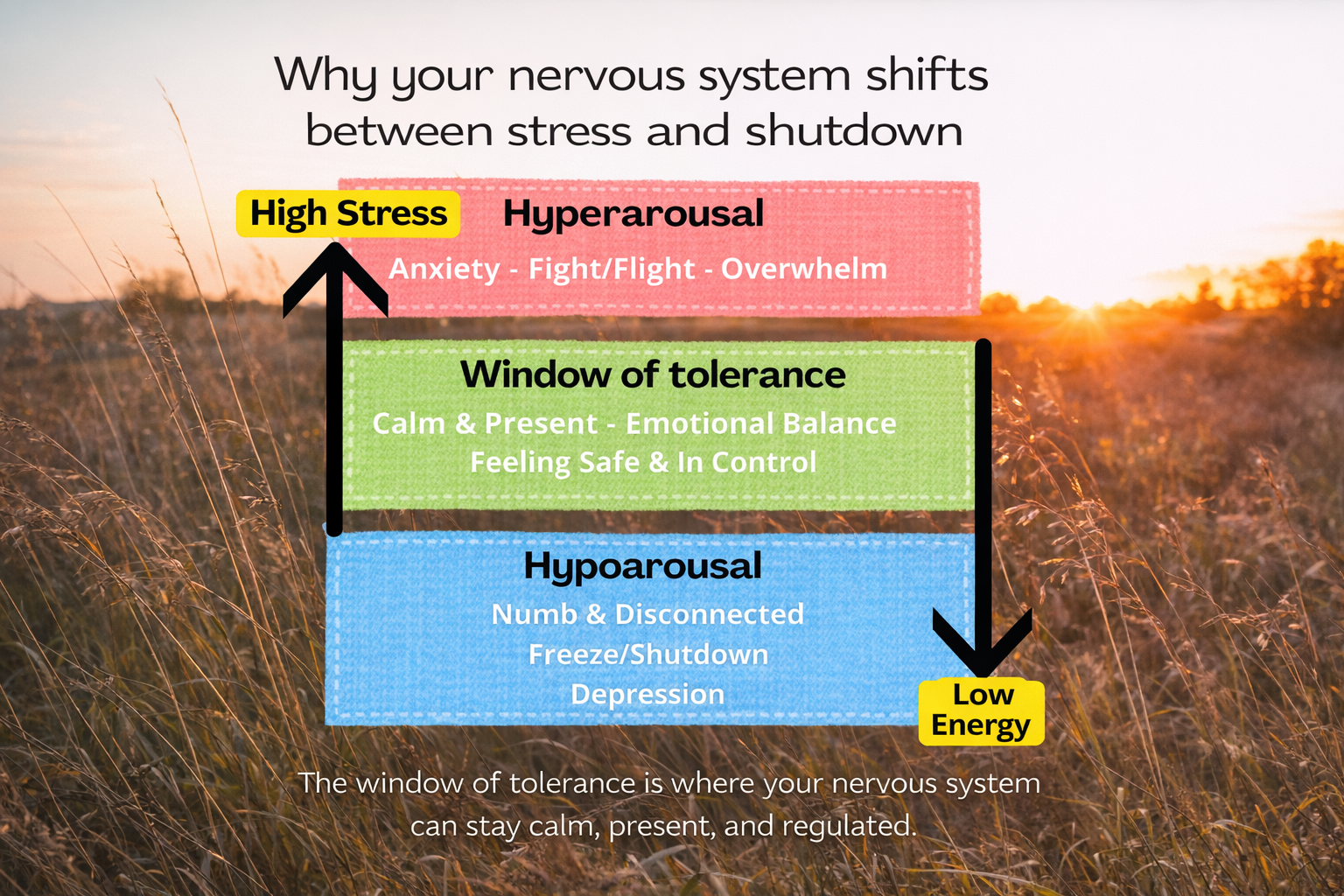
One of the most useful concepts for understanding nervous system capacity is the window of tolerance.
The window of tolerance describes the range of emotional and physiological arousal in which the nervous system can function in a regulated way.
Inside this window, a person can experience emotions, challenges, and stimulation while remaining grounded.
Outside the window, the nervous system moves into survival responses.
When activation moves above the window, the body enters hyperarousal.
This may include:
• anxiety
• panic
• anger
• hypervigilance
• racing thoughts
When activation drops below the window, the body enters hypoarousal.
This may include:
• numbness
• shutdown
• dissociation
• exhaustion
• emotional withdrawal
Nervous system capacity determines how wide this window is.
A wider window allows the nervous system to process more experience without becoming dysregulated.
Here is a visual about how this looks like in life:
Modern life places significant pressure on the nervous system.
Many people today live with nervous systems that are already stretched beyond their natural capacity.
Several factors contribute to reduced nervous system resilience.
Chronic stress is one of the most common causes of reduced nervous system capacity.
Work pressure, financial uncertainty, social demands, and constant digital stimulation keep the body in a prolonged state of alertness.
When the nervous system remains activated for long periods without adequate recovery, its ability to process stress gradually decreases.
Trauma has a profound impact on nervous system functioning.
Traumatic experiences alter how the nervous system interprets safety and danger.
After trauma, the nervous system may remain highly sensitive to perceived threats.
Situations that appear neutral or safe may trigger survival responses because the body is attempting to prevent further harm.
This heightened sensitivity reduces the nervous system’s tolerance for stimulation.
Many people learn early in life that certain emotions are unacceptable or unsafe to express.
As a result, emotions are suppressed rather than processed.
Suppressing emotions requires significant physiological effort.
Over time this effort reduces the nervous system’s available capacity.
Burnout occurs when prolonged stress exceeds the body’s ability to recover.
During burnout, the nervous system becomes exhausted.
Energy reserves are depleted, and the body may shift into shutdown responses.
This dramatically lowers nervous system capacity.
Low nervous system capacity can manifest in many different ways.
Because the nervous system regulates both physical and emotional processes, symptoms may appear across multiple areas of life.
Common signs include:
• feeling overwhelmed by relatively small stressors
• difficulty concentrating or making decisions
• emotional reactivity
• frequent anxiety or panic
• chronic fatigue
• irritability
• dissociation or numbness
• trouble sleeping
• brain fog
Some individuals alternate between periods of anxiety and periods of exhaustion.
Others may remain primarily in one pattern.
Both reflect a nervous system that is operating outside its optimal capacity.
Emotional regulation depends heavily on nervous system capacity.
When the nervous system has sufficient capacity, emotions can move through the body without becoming destabilizing.
A person can feel sadness, anger, or fear while remaining grounded and present.
When capacity is limited, emotions may feel overwhelming or intolerable.
This may lead to:
• emotional suppression
• explosive reactions
• withdrawal or shutdown
• avoidance of emotional situations
Understanding this connection can reduce self-judgment.
Many emotional struggles are not simply psychological issues but physiological ones.
Embodiment refers to the ability to remain present in the body and experience life through physical sensation and awareness.
However, when the nervous system is overwhelmed, the body may no longer feel like a safe place to inhabit.
Many people unconsciously disconnect from their bodies as a protective strategy.
This disconnection can appear as:
• difficulty sensing bodily signals
• numbness
• overthinking
• constant mental activity
Nervous system capacity influences how comfortable it feels to remain present in the body.
As capacity increases, the body becomes a more stable place to experience emotions, sensations, and relationships.
The nervous system continuously scans the environment for cues of safety or danger.
This process occurs automatically and largely outside conscious awareness.
When the body perceives safety:
• muscles relax
• breathing slows
• attention widens
• emotional regulation improves
When the body perceives danger:
• stress hormones increase
• heart rate rises
• attention narrows
• survival responses activate
Repeated experiences of safety help the nervous system develop greater resilience.
Over time this allows the body to process more stimulation without becoming overwhelmed.
Trauma often reduces nervous system capacity by narrowing the window of tolerance.
After trauma, the nervous system may remain highly vigilant.
The body becomes prepared for threat even when no immediate danger exists.
This heightened sensitivity can cause the nervous system to react quickly and intensely to stress.
Trauma-related nervous system patterns may include:
• hypervigilance
• exaggerated startle responses
• emotional flooding
• dissociation
• chronic muscle tension
These responses are protective adaptations.
They developed to help the body survive overwhelming experiences.
Understanding this can bring compassion to the healing process.
The modern world presents unique challenges to the nervous system.
Continuous stimulation, information overload, and social pressure can keep the body in a state of chronic activation.
Many people move through their days without adequate moments of rest, regulation, or emotional processing.
As a result, nervous system capacity may gradually decline over time.
This does not mean the body is permanently damaged.
The nervous system remains adaptable throughout life.
However, recognizing the limits of the nervous system is essential for maintaining long-term emotional and physical wellbeing.
Nervous system capacity plays a central role in how we experience stress, emotion, and personal growth.
It determines how much stimulation the body can process while remaining stable and present.
When capacity is limited, life can feel overwhelming and unpredictable.
When capacity is stronger, the nervous system can hold more experience without shifting into survival responses.
Understanding nervous system capacity provides a powerful framework for understanding emotional resilience, trauma healing, and embodiment.
Rather than seeing emotional struggles as personal failures, they can be understood as signals from the nervous system about its current capacity.
With this perspective, healing becomes less about forcing change and more about respecting the rhythms and needs of the body.
Welcome home beautiful!

Many women are exploring nervous system healing have questions about how the nervous system processes stress and emotional experiences. Below are answers to some of the most common questions about nervous system capacity.
A: Nervous system capacity refers to the amount of stress, emotion, stimulation, and life experience the nervous system can process without becoming overwhelmed. When capacity is strong, the body can remain regulated during challenges. When capacity is limited, even small stressors may trigger anxiety, shutdown, or emotional overwhelm.
A: Nervous system capacity can be influenced by chronic stress, unresolved trauma, emotional suppression, burnout, and prolonged overstimulation. When the body experiences too much stress without adequate recovery, the nervous system may become more reactive and less able to process additional pressure or emotional intensity.
A: Nervous system capacity and emotional resilience are closely connected but not identical. Nervous system capacity describes the body’s physiological ability to process stimulation and stress, while emotional resilience refers to how well someone can adapt to challenges and recover from difficult experiences.
A: Yes. Nervous system capacity is not fixed. The nervous system is adaptable and capable of change throughout life. With supportive environments, regulation, and gradual healing, the nervous system can become more flexible and resilient, allowing it to tolerate more emotional and sensory experiences.
A: When the nervous system experiences more stimulation or stress than it can process, it may activate survival responses. This can appear as anxiety, panic, irritability, emotional flooding, or hypervigilance. In other cases the nervous system may shift into shutdown responses such as numbness, exhaustion, or dissociation.
A: Nervous system capacity influences how someone handles pressure, relationships, emotional experiences, and change. When capacity is limited, everyday situations may feel overwhelming. When capacity is stronger, the nervous system can remain stable and responsive even when life becomes challenging or unpredictable.
A: The window of tolerance describes the range of emotional activation in which the nervous system can function in a balanced state. Nervous system capacity determines how wide this window is. A wider window allows someone to experience stronger emotions or stress while remaining regulated.
A: Trauma can change how the nervous system interprets safety and danger. After overwhelming experiences, the body may remain more sensitive to perceived threats. This heightened alertness can narrow the window of tolerance and make the nervous system react more quickly to stress or emotional intensity.
A: When nervous system capacity is limited, even minor challenges can exceed the body’s ability to regulate. Situations that seem manageable to others may trigger strong emotional or physiological responses because the nervous system is already operating near its threshold for stress.
A: Nervous system regulation refers to the ability to return to a calm and balanced state after stress. Nervous system capacity refers to how much stress or stimulation the body can handle before dysregulation occurs. Regulation helps stabilize the system, while capacity determines its overall resilience.
A: Chronic stress keeps the nervous system in a prolonged state of activation. Over time this can deplete the body’s energy reserves and reduce its ability to process additional stimulation. When stress continues without adequate recovery, the nervous system may become more reactive or easily overwhelmed.
A: Nervous system capacity creates the foundation for emotional processing and trauma healing. When the body has enough capacity, it can experience emotions and memories without becoming destabilized. Without sufficient capacity, deeper emotional work may feel overwhelming for the nervous system.
A: Embodiment involves being present in the body and aware of physical sensations. When nervous system capacity is limited, the body may feel unsafe to inhabit, leading to disconnection or overthinking. As capacity strengthens, it often becomes easier to remain present in bodily sensations and emotions.
A: Yes. Nervous system capacity affects how people respond to conflict, emotional intensity, and closeness in relationships. When capacity is limited, interactions may quickly trigger stress responses. With stronger capacity, individuals can stay more present and regulated during emotional conversations.
A: Modern environments often expose the nervous system to constant stimulation, digital input, social pressure, and fast-paced lifestyles. Without enough moments of rest and recovery, the nervous system can remain in a state of chronic activation, gradually reducing its ability to process additional stress.
GoddEssence Remembrance | Sidereal Astrology & Somatic Feminine Embodiment Coaching For Women
I support self-aware women in embodying their next level of leadership through nervous system regulation, grounding, and feminine sovereignty.
This is not about chasing another awakening. It is about living awake, anchored in the body, rooted in Source, and aligned with inner authority.
Created for women experiencing identity shifts, spiritual initiations, or the collapse of old structures, this work guides you to release what no longer serves, stabilize your nervous system, and reclaim embodied power.
Rooted. Grounded. Sovereign.
Welcome home to your throne beautiful!✨⭐✨