Subscribe to receive Your Star Essences: reflections, energetic guidance, and grounded tools to help you lead from alignment.
To understand why your nervous system shifts between stress and shutdown, it helps to look at how the body responds to stress.
The nervous system constantly scans the environment for signals of safety or danger. When the body perceives stress or threat, it activates survival responses designed to protect you.
Sometimes the nervous system responds with stress activation, also called hyperarousal.
At other times, especially when stress feels overwhelming or inescapable, the nervous system may respond with shutdown, known as hypoarousal.
These two states form a protective cycle. The body first attempts to mobilize energy through stress activation. If that energy cannot resolve the situation, the nervous system may shift into shutdown.
This is why you may experience a cycle where the nervous system shifts between stress and shutdown, especially during periods of chronic stress or emotional overwhelm.
Many women are seeing that their nervous system shifts between stress and shutdown, sometimes even within the same day.
One moment you may feel anxious, restless, or overwhelmed. Your body feels activated, your thoughts may be racing, and it can feel difficult to slow down.
Then, later in the day, something different may happen.
Instead of feeling stressed, your body may feel heavy, numb, or emotionally disconnected.
You may experience:
• fatigue
• lack of motivation
• brain fog
• emotional numbness
This pattern often reflects nervous system dysregulation.
When the nervous system becomes dysregulated, it may move repeatedly between two survival states:
• stress activation (hyperarousal)
• shutdown or freeze (hypoarousal)
These shifts are not random. They are part of how the nervous system protects the body from overwhelm.
Understanding why the nervous system shifts between stress and shutdown can help you recognize your body’s patterns and begin supporting nervous system regulation.
The concept of the window of tolerance helps explain why the nervous system shifts between stress and shutdown.
The window of tolerance describes the range where the nervous system can experience emotions, stimulation, and stress while remaining regulated.
When a person stays within this window, the nervous system can process experiences without becoming overwhelmed.
However, when stress pushes the body outside this range, the nervous system may shift into hyperarousal (stress activation) or hypoarousal (shutdown).
This is why someone may feel anxious and overwhelmed one moment, and later feel numb or exhausted. The nervous system is moving between two survival states.
Understanding the window of tolerance helps explain why the nervous system shifts between stress and shutdown during periods of prolonged stress or emotional overwhelm.
See here an overview of this:
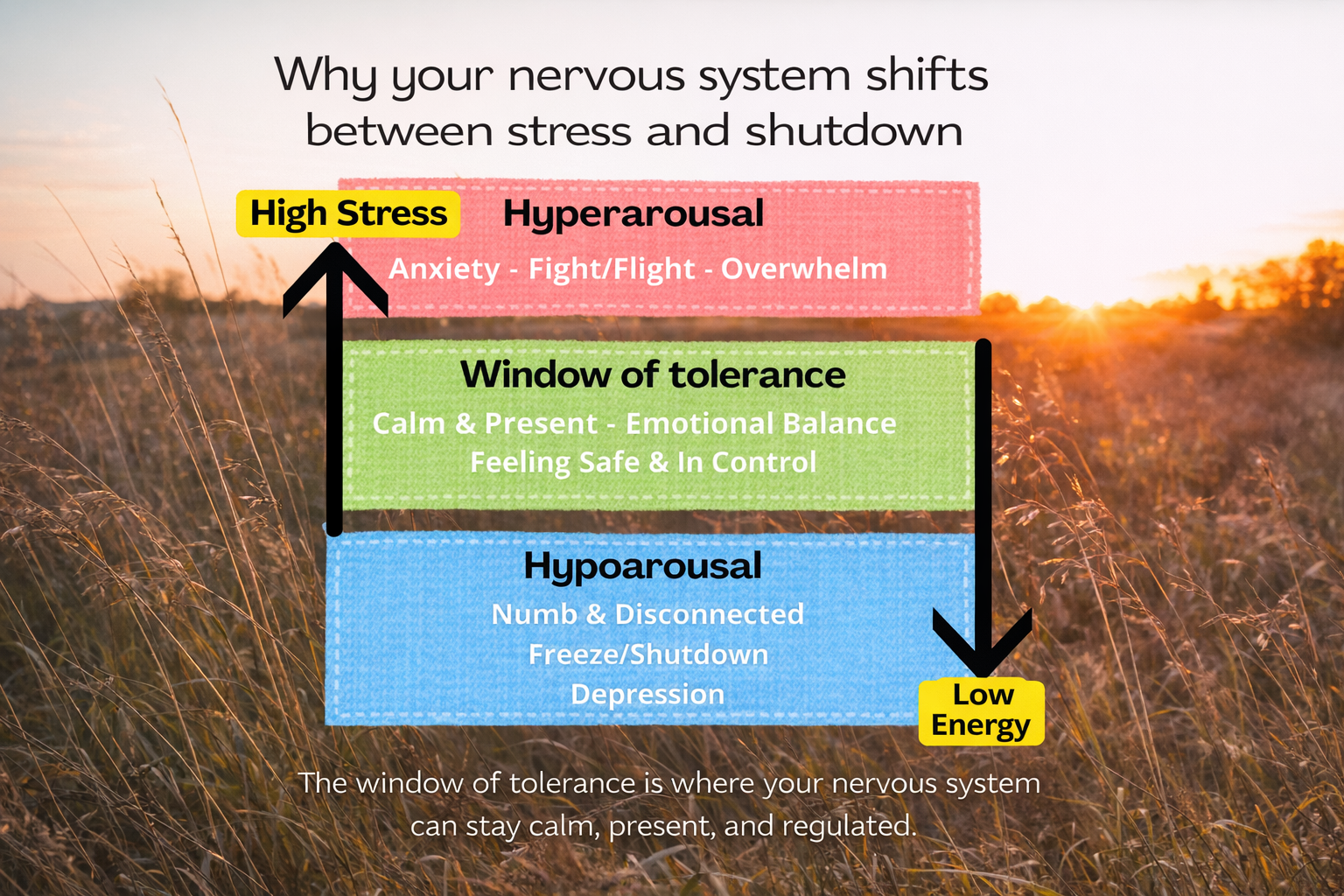
Hyperarousal occurs when the nervous system becomes highly activated in response to perceived danger or pressure.
In this state, the body shifts into sympathetic nervous system activation, often known as the fight-or-flight response.
Common signs of hyperarousal include:
• anxiety
• racing thoughts
• irritability
• muscle tension
• difficulty relaxing
• feeling constantly “on edge”
When the nervous system spends too much time in stress activation, it becomes harder for the body to return to a calm state.
Over time, this constant activation can contribute to nervous system dysregulation, where the body struggles to shift back into balance.
Many are experiencing burnout, chronic stress, or trauma spend long periods in this hyperarousal state of the nervous system.
If stress becomes too overwhelming, the nervous system may shift into the opposite state: shutdown.
This state is called hypoarousal.
Hypoarousal is associated with the freeze response, where the body conserves energy and reduces emotional engagement.
Instead of feeling activated, the nervous system begins to slow down.
Common signs of hypoarousal include:
• emotional numbness
• exhaustion
• dissociation
• brain fog
• feeling disconnected from the body
• low motivation
While shutdown can feel confusing or frustrating, it is actually a protective nervous system response.
When the nervous system perceives that stress cannot be escaped or resolved, it may shift into shutdown to reduce overwhelm.
When someone experiences nervous system dysregulation, the body may repeatedly cycle between hyperarousal and hypoarousal.
This happens when the nervous system struggles to remain inside the window of tolerance.
For example:
A person may experience hyperarousal, feeling anxious, pressured, or overstimulated.
If that stress continues for too long, the nervous system may move into hypoarousal, leading to exhaustion, emotional numbness, or withdrawal.
This cycle between stress and shutdown is common in what many are experiencing:
• chronic stress
• trauma
• burnout
• emotional overwhelm
The nervous system is not malfunctioning when this happens.
It is simply trying to protect the body from overload.
Healing the nervous system does not mean eliminating stress completely.
Instead, the goal is to expand the window of tolerance, allowing the nervous system to experience stress without becoming overwhelmed or shutting down.
When the window of tolerance expands, the nervous system becomes more flexible.
A person may still experience stress, but the body can return more easily to a regulated state.
Practices that support nervous system regulation include:
• somatic awareness
• grounding practices
• breath regulation
• gentle movement
• supportive relationships and co-regulation
Over time, these experiences help the nervous system learn that it is safe to remain present in the body.
As regulation improves, the body becomes less likely to shift abruptly between stress activation and shutdown.
When you learn why their nervous system shifts between stress and shutdown, they often realize that their body is not broken.
These shifts are natural nervous system responses designed to protect the body during overwhelming experiences.
Stress activation and shutdown are both part of the body’s survival system. The goal of healing is not to eliminate stress completely, but to help the nervous system regain flexibility.
As the nervous system becomes more regulated, it becomes easier for the body to stay within the window of tolerance and move through stress without shifting abruptly into shutdown.
Over time, this greater nervous system balance supports emotional stability, resilience, and a deeper sense of safety in the body.
Welcome home beautiful!

GoddEssence Remembrance | Sidereal Astrology & Somatic Feminine Embodiment Coaching For Women
I support self-aware women in embodying their next level of leadership through nervous system regulation, grounding, and feminine sovereignty.
This is not about chasing another awakening. It is about living awake, anchored in the body, rooted in Source, and aligned with inner authority.
Created for women experiencing identity shifts, spiritual initiations, or the collapse of old structures, this work guides you to release what no longer serves, stabilize your nervous system, and reclaim embodied power.
Rooted. Grounded. Sovereign.
Welcome home to your throne beautiful!✨⭐✨